Introduction
LimeSDR GW Project Overview
This project provides gateware and firmware for the LimeSDR family of boards, which are popular for their versatility in Software Defined Radio (SDR) applications. The gateware runs on the FPGA to handle tasks like data pipelining/processing and hardware integration, while the firmware supports the embedded CPU for control and configuration. We tried our best to make it easy to maintain, customize, and expand the functionality of these SDR boards.
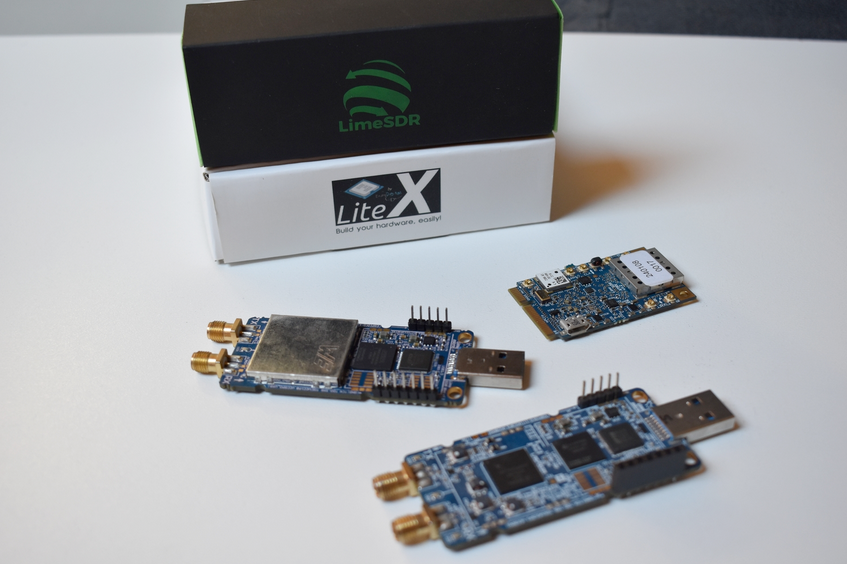
The LimeSDR_GW repository (available on GitHub at myriadrf/LimeSDR_GW) brings LiteX and LimeDFB together into a unified gateware ecosystem for LimeSDR variants (e.g., Mini V1/V2, XTRX). It replaces scattered, board-specific HDL projects with a systematic, sustainable framework that simplifies maintenance and adaptation across diverse FPGA architectures. The structure emphasizes modularity, with board-specific configurations in platforms/targets, custom logic in gateware, and firmware in its dedicated directory. This setup supports easy expansion, such as adding new boards or RF features, while promoting collaboration through standardized designs.
Core Framework: LiteX
At its core, the project is built on the LiteX framework, an open-source toolkit that uses Python to describe and build System-on-Chip (SoC) designs for FPGAs. LiteX automates many of the repetitive aspects of FPGA development, such as connecting buses, managing clocks and resets, integrating memory, integrating CPUs, and compiling firmware. This allows developers to spend more time on the unique parts of SDR systems, like RF signal handling, rather than getting bogged down in low-level details.
Some key advantages include:
Its vendor-neutral approach, which works across different FPGA makers like Xilinx, Altera, and Lattice.
Support for various soft-core processors like VexRiscv.
The ability to easily wrap and integrate existing Verilog or VHDL code.
Overall, it promotes reusability, makes designs more portable to new hardware, and fosters collaboration through cleaner, more modular code.
RF Processing: LimeDFB
Complementing LiteX is the LimeDFB library, which supplies modular VHDL components specifically designed for RF data processing, such as receive (RX) and transmit (TX) paths tailored to the LMS7002M transceiver found in LimeSDR boards. LimeDFB focuses on reusability (These components can be adapted for other RF transceivers without starting from scratch) and its emphasis on sustainability. By separating RF logic into standalone modules, it simplifies maintenance across multiple board variants and reduces duplication.
The advantages here include:
Easier expansion for new features or hardware changes.
Better organization of complex RF workflows.
A foundation that encourages community contributions to evolve SDR capabilities.
Documentation Overview
This documentation is organized into several sections to guide you through different aspects of the project. Here’s a quick overview of the main parts and when you might want to refer to them:
- Project Structure Project Structure
Check this if you’re new to the repository and want to understand how files and directories are organized, including how LiteX and LimeDFB fit together. It’s helpful for getting oriented before diving into code or builds.
- Gateware Description Gateware Description
Refer here for detailed explanations of the FPGA gateware for each supported board, including block diagrams and module breakdowns. Use it when you need to learn about the internal workings or troubleshoot specific hardware interactions.
- Building the Project Building the Project
This is your go-to for instructions on compiling gateware and firmware, including required tools and board-specific steps. Turn to it whenever you’re setting up a build environment or flashing a board.
- LiteX Basics LiteX Basics
Refer here for an introduction to LiteX concepts as used in LimeSDR_GW, including platforms, targets, wrappers, naming conventions, and portability tips. Useful if you’re new to LiteX or need a refresher on integration.
- Modifying the Project Modifying the Project
If you plan to customize gateware or firmware—such as adding modules like an FFT— this section provides examples and guidance on where to find sources and how to make changes safely.
- Adding a New Board Adding a New Board
Consult this if you’re extending the project to support custom SDR platforms or new hardware variants. It walks through the process step-by-step, from repository setup to verification.
- Best Practices Best Practices and Guidelines
Refer here for guidelines on naming conventions, portability, and CPU options in LiteX. Helpful for maintaining consistency and optimizing designs.
If anything remains unclear after exploring these sections, feel free to submit an issue on GitHub—contributions and feedback are always welcome!
Supported Boards
Board |
HW Version |
Description |
Toolchain |
|---|---|---|---|
LimeSDR XTRX |
v1.2+ |
Mini PCIe SDR board. |
Xilinx Vivado. Potential future OpenXC7 support. |
LimeSDR Mini V1 |
v1.x |
USB SDR board. |
Altera Quartus. |
LimeSDR Mini V2 |
v2.x |
USB SDR board. |
Open source flow with GHDL, Yosys, nextpnr. |
Open Source Tools
The project uses open source tools for flexibility and community input. Development has been done on Linux, where the tools and workflows integrate smoothly, but with some adaptations it could potentially run on other platforms.
Tool |
Link |
|---|---|
GHDL |
|
LiteX |
|
nextpnr |
|
prjtrellis |
|
OpenFPGALoader |
|
OpenOCD |
|
VexRiscv |
|
Yosys |
These tools handle tasks from synthesis and simulation to debugging and programming. The project sticks to open source where it can and should provide a good example in general of what open source FPGA development can be done with various open source tools available!